
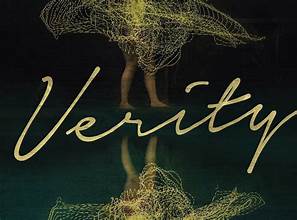
With my first draft of Nostalgia sent out to beta readers, I can finally take a breath and get caught up on my blog by writing a book review, specifically a review of Verity by Colleen Hoover.
The story starts when Lowen Ashleigh, a struggling young novelist, is hired to complete the best-selling series written by famous author Verity Crawford Crawford has suffered a severe brain injury in a recent car accident and is confined to her bed in a catatonic state. Her readers, who do not know the extent of her injuries, are restlessly awaiting her upcoming novels.
But of course, nothing is as it seems. When Lowen travels to the Crawford’s home to organize Verity’s notes, things get creepy. Verity’s young son describes conversations with his mother as if they are currently happening. He gets cut by a knife he says he found in Verity’s room, but when Lowen goes to retrieve it, the knife isn’t there.
What was supposed to be “a couple of days” of research is taking much longer than Lowen anticipated. In the meantime she resists the attraction she feels toward Jeremy and vows to get the information she needs and go home. More than once Lowen swears she sees Verity’s face in the window—far across the room from the bed to which she supposedly can’t leave.
The plot thickens when Lowen discovers a hidden manuscript, written by Verity, where she describes deceiving Jeremy, trying to abort a pregnancy, and causing the deaths of their twin daughters. Is she a psychopath? Should Lowen show the manuscript to Jeremy and shatter his illusions about his wife? It’s the stuff of a juicy enigma.
Verity was an excellent read, right up to the last chapter which, in my opinion, was totally unnecessary. Like a lot of recent novels, there is an epilogue (although in this case, it isn’t titled as such). Lowen and Jeremy are living happily ever after, she is seven months pregnant with their daughter.
Fine. I’m happy for them.
But then they return to Jeremy’s home in Vermont to get it ready for sale, and Lowen discovers a hidden cache in Verity’s room. Inside, among other things, is a letter. A confession of sorts from Verity that implies the “confessional” she wrote of death and deception, was all a writing exercise without a modicum of truth.
Why did the author feel the need to introduce this revelation? I don’t see a purpose for it. Yes, we can wonder if Verity was guilty or not, but to what end?
I dunno, it seems like filler to me. And I see it a lot lately in the novels I’ve read.
I was disappointed. My five-star plus review immediately gets demoted to four.
The conventional wisdom says that prologues are a no-no. Okay, I can deal with that (although I disagree). But it seems now that everyone feels the need to add an epilogue.
I’ve come to the point that I cringe when I see an epilogue. Why? Because most of the time it’s (a) unnecessary, or (b) not an epilogue at all, but an ending chapter. There’s a difference.
By all means. Read Verity. I think you’ll love it.
But beware that final chapter.

 Susannah Willey Writes
I remember reading this book a few years ago. It was very bizarre, but I’m finding more of the same type out there. Here’s the thing about epilogues–if there is an epilogue, there better be a prologue; and vice verse. Don’t do one without the other
LikeLike
Thanks for the review. I agree with the points you made. But overall, I enjoyed ‘Verity’ in comparison to Colleen Hoover’s other books.
LikeLike